

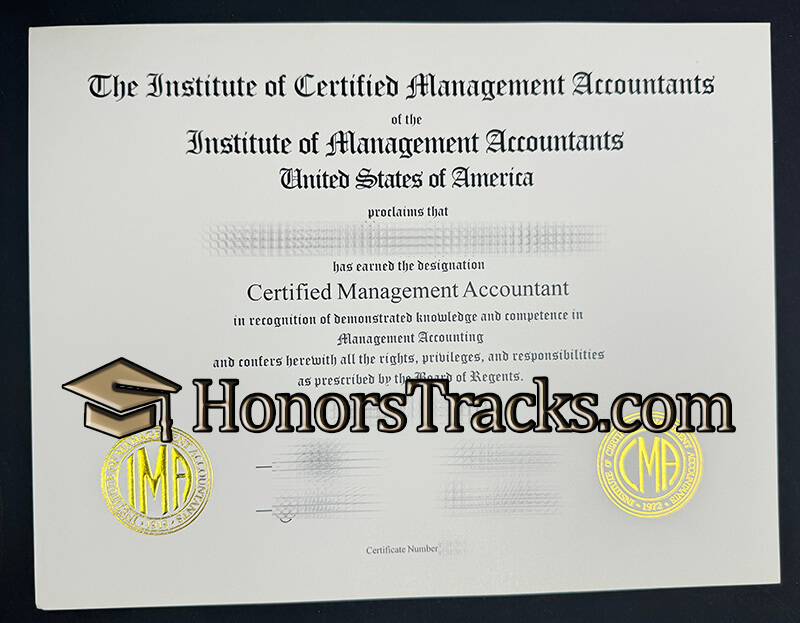
Certified Management Accountant (CMA) is a globally recognized professional credential focused on management accounting, financial management, and strategic decision-making. It is designed for finance professionals who want to develop expertise beyond traditional financial reporting and auditing. Order CMA Certificate replacement.

What is the CMA?
The CMA credential is awarded by the Institute of Management Accountants (IMA), a professional association based in the United States with members worldwide. The certification emphasizes skills needed for corporate finance, planning, analysis, performance management, and strategic leadership.
CMA
A management accounting and financial management credential awarded by the Institute of Management Accountants (IMA).
Key Areas of Knowledge
The CMA program covers topics such as:
-
Financial Planning and Analysis
Budgeting, forecasting, variance analysis, and performance measurement.
-
Cost Management
Costing methods, operational efficiency, and profitability analysis.
-
Internal Controls and Risk Management
Governance, compliance, and risk assessment.
-
Financial Statement Analysis
Interpreting financial information for business decisions.
-
Corporate Finance
Capital budgeting, financing decisions, and working capital management.
-
Strategic Management
Business strategy, decision analysis, and leadership.
CMA vs. CPA
|
Feature |
CMA |
CPA |
|
Primary Focus |
Management accounting and corporate finance |
Public accounting, auditing, taxation, and financial reporting |
|
Typical Roles |
Financial analyst, controller, finance manager, CFO |
Auditor, tax advisor, public accountant |
|
Strategic Emphasis |
High |
Moderate |
|
Common Employers |
Corporations, manufacturing firms, multinational companies |
Accounting firms, corporations, government agencies |
Many professionals choose the CMA when they are interested in internal corporate finance and management decision-making, while the CPA is often associated with public accounting and assurance services.
Eligibility Requirements
Requirements can vary slightly by jurisdiction, but the standard IMA requirements generally include:
-
Bachelor’s degree
From an accredited institution (or an approved equivalent).
-
Passing the CMA exam
Candidates must pass both parts of the CMA examination.
-
Professional experience
Typically two years of relevant management accounting or financial management experience.
-
IMA membership
Candidates must maintain membership in the Institute of Management Accountants.
Two-part exam
The CMA exam consists of two parts that test both technical knowledge and the ability to apply concepts to business situations.
Typical CMA Career Paths
CMA holders commonly work in roles such as:
-
Financial Analyst
Analyze performance, budgets, and forecasts.
-
Cost Accountant
Manage costing systems and profitability analysis.
-
Controller
Oversee accounting operations and internal reporting.
-
Finance Manager
Lead financial planning and decision support.
-
Chief Financial Officer (CFO)
Provide strategic financial leadership.
-
Business Consultant
Advise organizations on finance and performance improvement.
Benefits of Earning the CMA
-
Global recognition
The credential is respected by employers in many countries.
-
Career advancement
Can support progression into management and leadership roles.
-
Strategic finance skills
Focuses on decision-making, planning, and business strategy.
-
Competitive compensation
Many salary surveys show CMA holders often earn more than non-certified peers, though results vary by country and industry.
-
Professional network
Access to IMA resources, events, and continuing education.
The CMA is particularly valuable for professionals pursuing careers in corporate finance, management accounting, financial planning & analysis (FP&A), and executive financial leadership. It is especially attractive for those who want to influence business decisions rather than focus primarily on external auditing or tax work.
If you’re considering the CMA, a useful next step is to compare it with credentials such as CPA, ACCA, or CFA based on your desired career path.