

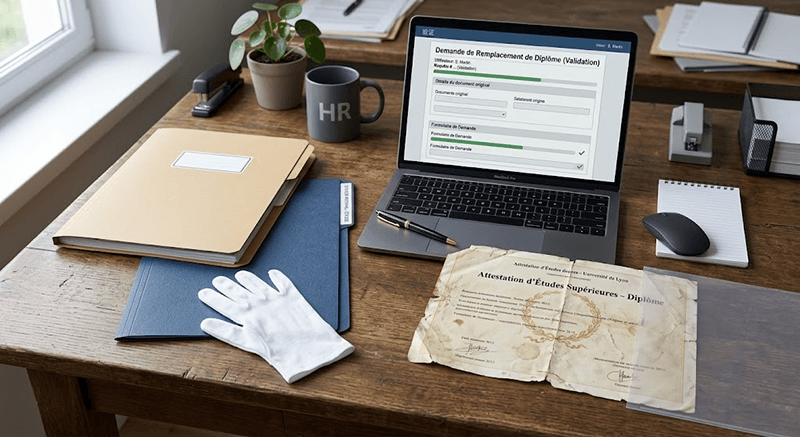
What to Do If Your Diploma Is Damaged
A damaged diploma can be frustrating, especially if it was framed, stored for years, or needed for an important purpose. Water, sunlight, heat, smoke, poor framing, and moving damage can all affect the paper. To compare official proof options, see replacement diploma vs official transcript
The first step is to decide whether you need an official replacement, an official transcript, or only a display copy.
Do Not Try to “Fix” Official Damage First
If your diploma has water stains, torn paper, faded ink, or frame damage, avoid aggressive cleaning. Do not use tape, glue, heat, bleach, or household cleaners.
These can make the damage worse and may affect the document’s appearance permanently.
Take Photos of the Damage
Before removing the diploma from a frame or folder, take clear photos.
Photograph:
– full document
– damaged area
– frame damage
– water stains
– tears or folds
– mailing envelope, if recently delivered damaged
If the diploma arrived damaged from the school or printer, photos may help when contacting the registrar.
Contact the Registrar
The registrar or records office is usually the correct place to request a replacement diploma. Search the school website for:
– replacement diploma
– duplicate diploma
– diploma reorder
– damaged diploma
– registrar records
– student records
Some schools use third-party credential services, but the official record still comes from the institution.
Replacement Diploma vs Transcript
A replacement diploma gives you a new printed document for display or personal records.
An official transcript may be better if you need proof quickly. Transcripts often show degree information, dates, courses, grades, credits, and academic history.
If an employer or school asks for proof, ask whether they require:
– official transcript
– degree verification
– registrar letter
– digital diploma
– replacement diploma
If You Need a Display Copy
If the damaged diploma was mainly used for wall display, a display copy may be useful while your official replacement is being processed.
A display copy may be used for:
– office decoration
– home office display
– photography
– film or theater props
– collection
It must not be used for:
– job applications
– university admission
– immigration records
– professional licensing
– background checks
– government forms
How to Protect the New Diploma
Once you receive a replacement, protect it carefully.
Use:
– archival-quality frame materials
– acid-free backing
– UV-protective glass
– dry indoor storage
– low-humidity environment
– secure digital scan for personal reference
Avoid:
– direct sunlight
– heat-based framing
– damp rooms
– basements
– cheap tape or glue
– rolling the document tightly
Store the Original Safely
If the damaged diploma still has sentimental value, store it flat in an acid-free folder or sleeve. Even if it is no longer suitable for display, it may still be meaningful as a personal keepsake.
Final Thoughts
If your diploma is damaged, do not panic. Photograph the damage, contact the registrar, and ask about the official replacement process. If you need proof quickly, use an official transcript or degree verification.
For decoration, a display copy can help protect the official document, but it should never be used as academic proof.
FAQ
Can I replace a damaged diploma?
Usually yes, if the school offers replacement or duplicate diplomas.
Should I repair a damaged diploma myself?
No. Avoid tape, glue, heat, bleach, or harsh cleaning.
Is a transcript better if I need proof quickly?
Often yes. An official transcript may be faster and more detailed.
Can I display a copy instead of the original?
Yes, for decoration or personal display.
Can a display copy be used for verification?
No. Use official records for verification.